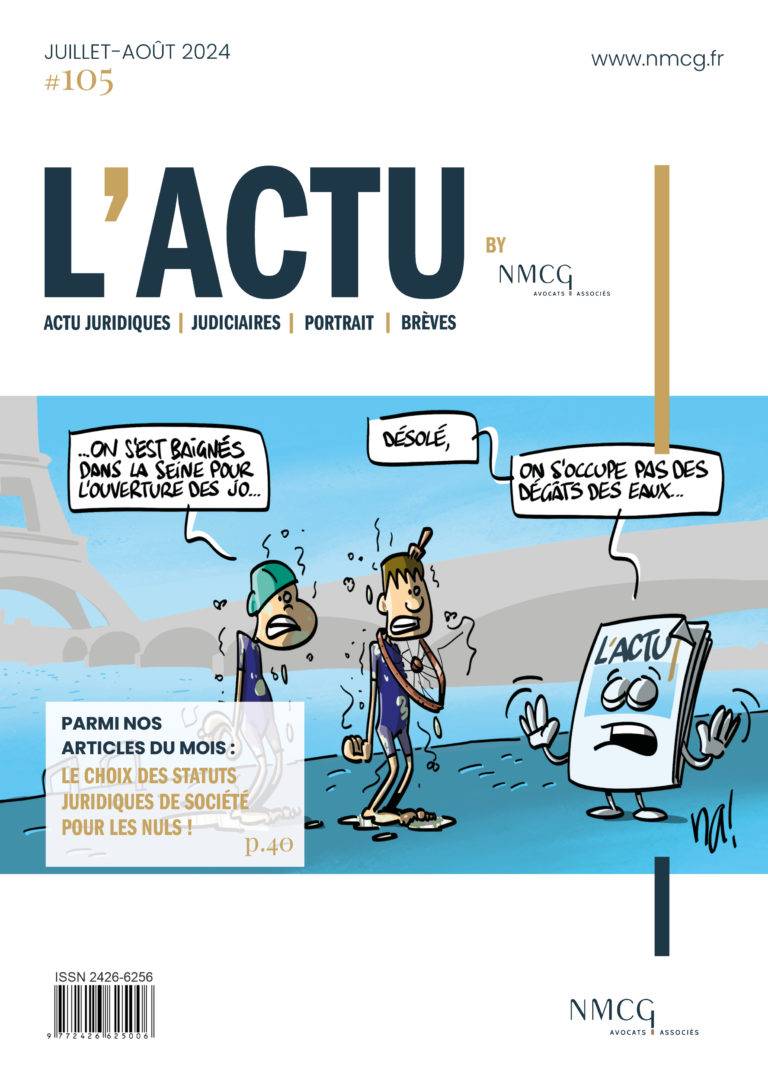

Whoever wins the auction has to pay… and can be condemned to do so!
3 July 2024
The President of the Paris Court of First Instance1 recently issued an interim ruling on the possibility for a voluntary sales operator (VSO) to take legal action to obtain an order for payment from a defaulting buyer. Summary proceedings are accelerated and simplified procedures, often justified by the urgency of the situation, which should enable individuals to obtain a court decision within a shorter timeframe. Article 835 paragraph 2 of the Code of Civil Procedure provides that a creditor may apply, in summary proceedings, for an advance payment to be made where the pecuniary obligation is not seriously disputable. It was on the basis of this article that the President of the Paris Court of First Instance was seised in our case. The facts were as follows. At the end of 2021, Piasa, a voluntary auction operator, organised two auctions: the first sale focused on French design, the second on Italian design. During these sales, a buyer acquired five lots in the first sale, for a total of 65,390 euros, and seven other lots in the second sale, for a total of 80,340 euros. Despite numerous exchanges between Piasa’s representative and the buyer, the latter never paid the sums due for the purchase of these items, despite undertaking to do so by mid-February 2022. A formal notice was finally sent to the purchaser on 30 March 2022. When this was unsuccessful, the company brought an interlocutory injunction against the buyer on 29 June 2023. To rule on the admissibility and merits of the action brought before it, the court had to examine two points: Can a Voluntary Sales Operator (VSO) take legal action to obtain payment from the defaulting buyer? In such a case, is the auction claim not seriously contestable?
- Direct action by the OVV against the winning bidder
Under the terms of article L.321-14 paragraph 1 of the French Commercial Code: ‘The operators of voluntary sales of furniture by public auction mentioned in article L.321-4 are liable to the seller and the buyer for the representation of the price and delivery of which they have carried out the sale’. The judge deduced from this paragraph that OVVs are entitled to take action against buyers to recover the price and costs, without any other conditions. However, this was not the interpretation adopted by the Court of Cassation a few days before this decision was handed down, on 27 March 20242. In fact, the High Court had upheld a ruling by the Paris Court of Appeal3 in which it considered that although the auctioneer was indeed the seller’s legal agent, the action for payment of the price against the defaulting buyer did not fall within the scope of this mandate. The auction operator could not therefore act directly against the buyer, unless it had granted the seller an advance on the auction price of the property sold, which would authorise it to subrogate the seller’s rights, or unless it had a special power of attorney to represent the buyer in court. The decision does not specify whether the OVV advanced the seller the price of the property put up for sale. However, it is noteworthy that Piasa’s claims for payment related to only six of the twelve lots purchased, and we can assume that the buyer had in fact paid part of the sums due. As a result, the OVV would have transferred these sums to the sellers, thus constituting an advance. Since the OVV had standing to bring an action against the buyer, it remains to be seen whether there was a claim that could not be seriously contested.
- The absence of a seriously disputable claim
Two obligations of the defaulting buyer were at issue in this case. Article 321-14 paragraph 3 of the French Commercial Code provides that in the event of non-payment by the successful bidder after a formal notice has been served in vain,
- Either the property concerned is put back up for sale if the seller has made a request to this effect within 3 months of the initial sale;
- Either the sale is cancelled ipso jure.
And when the seller decides to put his property back up for sale, the original buyer owes him the difference in price that would result from a resale at a lower price than the original auction price, without being able to claim reimbursement of the sums he has already paid4. As a result, the legislation is particularly protective of sellers since, contrary to the retroactive effects of rescission, the seller may keep the sums already paid by the defaulting buyer, who remains liable for payment of the auction price even if the sale has been terminated. In this case, Piasa asked the judge to order the buyer to pay, as a provisional payment :
- The sum of €56,555 corresponding to the auction price and the buyer’s costs of three of the lots from the sale of Italian design, plus statutory interest from the date of the formal notice (i.e. 30 March 2022); and
- The sum of €36,400 corresponding to the difference in price resulting from the re-bidding of the three lots put back up for sale.
In holding that there was a claim that was neither seriously disputable nor contested by the purchaser, the Chairman based his decision on a large number of items submitted for discussion, namely : > sales reports, > award slips, > the general terms and conditions of Piasa, > constant minutes, > SMS exchanges between the two parties > and the buyer’s undertaking to pay his debt, and the formal notice sent in March 2022. The Piasa auction house therefore based its claim on numerous pieces of evidence, enabling the Chairman to accept the claims in full. This decision is therefore of particular interest to VSOs, as it recognises the possibility for them to act quickly (less than a year elapsed between the date of the writ of summons and the date of the order) and effectively (since it allows payment of the claim) against defaulting purchasers. However, we will have to keep a close eye on future developments in case law regarding the standing of VGOs to act on behalf of their purchasers and any conditions to which their direct action may be subject. 1 – TJ Paris, service des référés, 18 April 2024, RG n°23/55358. This highly instructive decision was mentioned in Marine Le Bihan’s Linkedin news feed, a rich and fascinating daily source of information on the art market. 2 – Cass. 1e civ. 27 March 2024, no. 21-22.016 3 – CA Paris, Pôle 4 – ch. 13, 1 June 2021, no. 18/28483 4 – Article L.322-12 of the Code of Civil Enforcement Procedures.