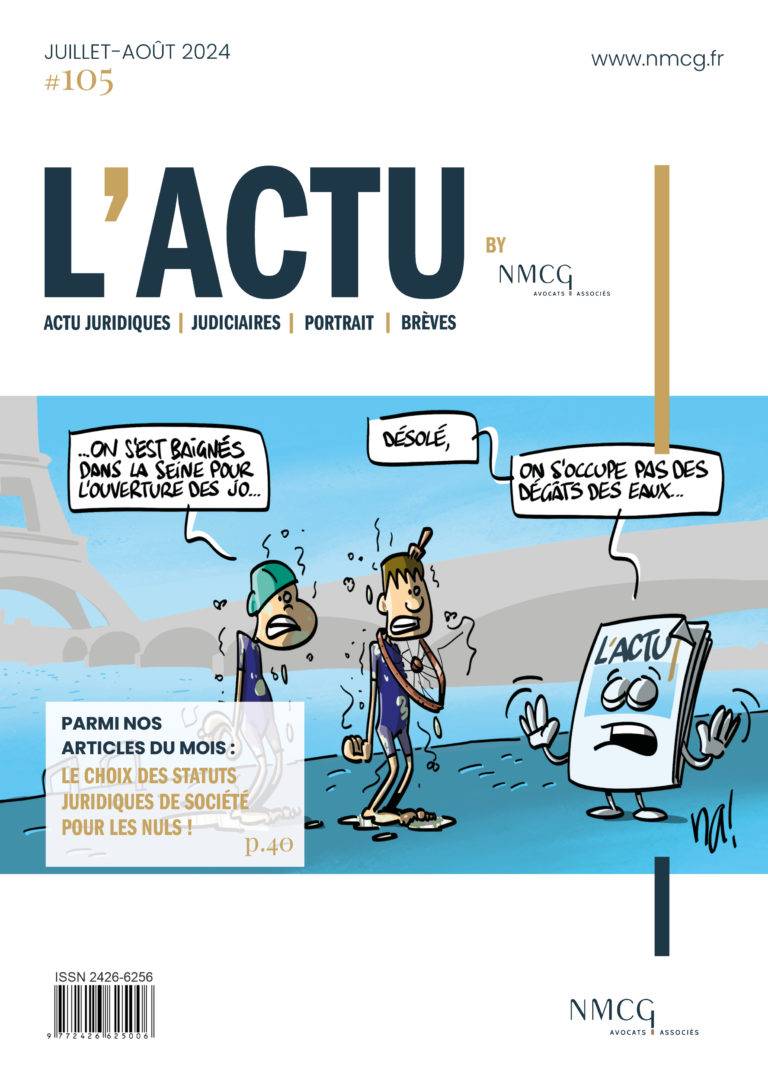
Choosing company legal forms for dummies!
26 July 2024
A company’s legal status is crucial, because it determines the rules that apply to it, as well as its operation, management, organisation and taxation. As a result, there are a large number of different legal forms: civil or commercial, capital or partnership, limited or unlimited risk. These have different effects on the creation, life and dissolution of the company in question. A number of parameters therefore need to be taken into account in order to choose the most appropriate legal status. These parameters may include: the company’s activity, the number of partners and their liability, the amount of capital contributions or whether the company is listed on the stock exchange. These factors need to be taken into account both when the company is set up and when it undergoes a transformation (change of legal form).
- Different types of company
The first step is to determine the nature of the business carried on within the company. This may be commercial or civil, and will determine the legal form of the company created. In addition, the number of partners, the amount of contributions and the conditions for transferring shares will also be factors to be taken into account when choosing the legal form.
- COMMERCIAL COMPANIES
– Société anonyme (SA): is a joint-stock company where shareholders are only liable for the company’s debts up to the amount of their contributions. This type of company is ideally suited to large companies, as it does not have a maximum threshold of shareholders present in the share capital. As a result, they benefit from a system of governance adapted to their size, usually comprising a Board of Directors, a Chairman (who may also be the Chairman of the Board of Directors) and a Chief Executive Officer. This system provides a high degree of control over the company’s activities and its governing bodies, as the legal status of a public limited company allows the company to be listed on the stock exchange and thus benefit from capital via the financial markets. Because of its size, governance and the possibility of being listed on the stock exchange, a public limited company is subject to extensive regulation, is subject to a degree of rigidity in its articles of association and has a minimum share capital of €37,000. It will therefore be necessary to take these factors into account if greater latitude is desired in the organisation and management of the company. – Société par actions simplifiée (SAS): the SAS is the most common form of company in France. This is due to the great flexibility of its articles of association. It is possible to determine the way it operates, particularly in terms of governance and decision-making, by specifying the method of decision-making (general meeting or written consultation) and the rules governing majorities and quorums. The transfer of shares is free, but may be governed by approval or pre-emption mechanisms. These possibilities make the SAS a great success, enabling entrepreneurs to organise their company in a unique way. What’s more, the SAS is also a limited liability company, with shareholders bound only by the amount of their contributions and with share capital that can be built up from as little as €1. However, because it is so flexible, the simplified joint-stock company requires extra care when drafting its articles of association. It will be necessary to anticipate potential problems relating to the company’s business, governance and the transfer of shares, in order to prepare a response in the articles. The drafting of a shareholders’ agreement can also be a useful tool for guarding against potential conflicts. – Société à responsabilité limitée (SARL): as its name suggests, the partners are, once again, bound only by the amount of their contributions. It is more suitable for small and medium-sized businesses than the SA or SAS, because it has a limit of 100 partners and does not require a minimum amount of share capital. In addition, it must be managed by a natural person, who may or may not be a partner in the SARL. The SARL legal form is also an attractive option for family businesses. It is possible to set up a ‘family limited liability company’ when the partners are members of the same family, provided that the conditions governing its formation are met. This status will make it easier to transfer and manage the company in order to protect family assets. However, care should be taken with this option, as it will subsequently become impossible to bring in new partners who are not members of the family. This could deprive the company of outside financing.
- CIVIL PARTNERSHIPS
– Société civile immobilière (SCI): is a partnership for the purchase, rental and management of one or more properties by a minimum of 2 partners. This type of company is ideally suited to property investments, as it allows the financial resources of several people to be pooled. It can also be used to increase their bank borrowing capacity for a property transaction. In addition to the management or rental SCI, there are various other types of SCI that can be set up. An SCI can be set up for the purpose of building and selling a property, by buying a plot of land on which to build a property. It is also possible to set up an SCI for timeshare to share the use of the property. In addition, there is also the SCI d’attribution, which designates precisely the part of the property held by each partner. However, the société civile immobilière does not allow certain activities to be carried out, as its purpose cannot be to carry out a commercial activity by its very nature. As a result, property dealing, which involves buying property with a view to reselling it, is not possible as a principal activity. The liability of SCI partners is another point to bear in mind. If the company’s creditors take legal action against the company and this action is unsuccessful, the partners will be liable for the company’s debts out of their personal assets. – Société civile patrimoniale (SCP): is relatively similar to the SCI, as it allows property to be purchased, rented out and transferred. However, it differs in that it also includes the holding of financial securities. In broader terms, it therefore allows investment in the capital of third-party companies. In addition, it is an interesting tool for transferring assets as part of an inheritance. Such transfers can be facilitated by appropriate articles of association. The choice of a company’s legal form is therefore extremely important for the company, whether it is to be set up or transformed, as it will determine its entire activity, how it operates and how it evolves. It is therefore necessary to be accompanied, both in the choice of the legal form of the company and in the drafting of its Articles of Association. NMCG will be happy to help.